Doges' Palace
Da Venicewiki, il wiki di Venezia
(Nuova pagina: 45.433530084184866, 12.340307235717773 <poem> <flickr>1871353831|right</flickr>The '''Doges' Palace''' was founded by Angelo Partecipazio in 814 approximately, renovated in 977 by the ...) |
|||
| Riga 1: | Riga 1: | ||
| - | 45.433530084184866, 12.340307235717773 | ||
<poem> | <poem> | ||
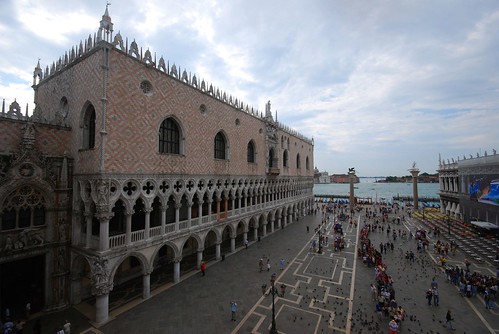
| - | <flickr>1871353831|right</flickr>The '''Doges' Palace''' was founded by Angelo Partecipazio in 814 approximately, renovated in 977 by the Doge Pietro Orseolo I, and expanded in 1173 by the Doge Sebastiano Ziani. | + | <flickr>1871353831|right</flickr>The '''Doges' Palace''' was founded by '''Angelo Partecipazio''' in 814 approximately, renovated in 977 by the Doge '''Pietro Orseolo I''', and expanded in 1173 by the Doge '''Sebastiano Ziani'''. |
The first form of the '''Palazzo Ducale''' was like a castle, surrounded by walls and towers at the corners. Was destroyed by fire. | The first form of the '''Palazzo Ducale''' was like a castle, surrounded by walls and towers at the corners. Was destroyed by fire. | ||
In the fourteenth century took to rifabbricarlo, and the work of expansion continued in later ages, including consideration of readjustments that took place after another fire, which occurred in 1483, 1574 and, perhaps the most terrible, in 1577. | In the fourteenth century took to rifabbricarlo, and the work of expansion continued in later ages, including consideration of readjustments that took place after another fire, which occurred in 1483, 1574 and, perhaps the most terrible, in 1577. | ||
| Riga 7: | Riga 6: | ||
<flickr>6823384818|left</flickr>Even watching from outside perceives the grandeur and the manifest capacity of the Doges that have followed, to prove to their people first, but also to the various rulers who came to visit the city, the power of the medieval city without defensive walls but a [[Laguna]] which has proven its strength over the centuries. | <flickr>6823384818|left</flickr>Even watching from outside perceives the grandeur and the manifest capacity of the Doges that have followed, to prove to their people first, but also to the various rulers who came to visit the city, the power of the medieval city without defensive walls but a [[Laguna]] which has proven its strength over the centuries. | ||
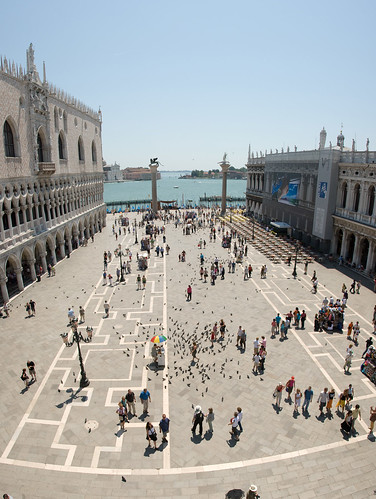
| - | In 1342 construction began on the facade of St. Mark's Basin and was commissioned Filippo Calendario to build on the existing structures, a building that could house the nearly one thousand noble representatives for the assemblies that were to decide the fate of [[Venice]]. The same calendar carved reliefs that adorn the edges of the front, dedicating to Adam and Eve on the edge Piazzetta and drunkenness of Noah to the [[Ponte della Paglia]]. | + | In 1342 construction began on the facade of [[Bacino di San Marco|St. Mark's Basin]] and was commissioned '''Filippo Calendario''' to build on the existing structures, a building that could house the nearly one thousand noble representatives for the assemblies that were to decide the fate of [[Venice]]. The same calendar carved reliefs that adorn the edges of the front, dedicating to Adam and Eve on the edge Piazzetta and drunkenness of Noah to the [[Ponte della Paglia]]. |
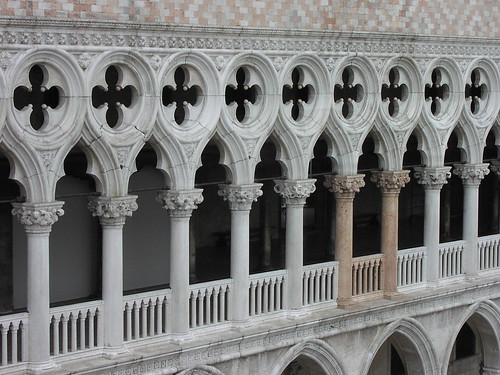
<flickr>6336907917|right</flickr>It is thought that some capitals of the Ducal Palace of the ground floor, dating back to the fourteenth century, are part of the work performed by Calendar and still in place as when it was proto [[Bartolomeo Bon]], while part of the capitals were replaced, because degraded, in the nineteenth century and form the Museum of the work which is accessed behind the ticket office of the Palace. | <flickr>6336907917|right</flickr>It is thought that some capitals of the Ducal Palace of the ground floor, dating back to the fourteenth century, are part of the work performed by Calendar and still in place as when it was proto [[Bartolomeo Bon]], while part of the capitals were replaced, because degraded, in the nineteenth century and form the Museum of the work which is accessed behind the ticket office of the Palace. | ||
| Riga 17: | Riga 16: | ||
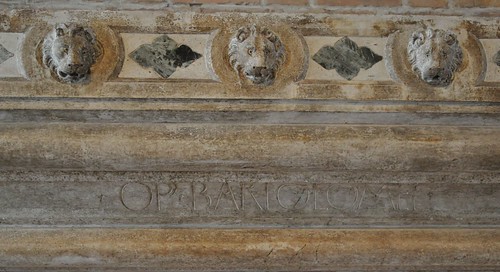
<flickr>6291687504|left</flickr>The main door of access to the [[Palazzo Ducale]] was the one next to the [[Basilica di San Marco]], called the Gate of the Charter. E 'was commissioned to [[Bartolomeo Bon]] and so signed by the same lintel OP. BARTOLOMEI. Today, however, the audience is made to enter the other entrance on Pier called Gate of Wheat. | <flickr>6291687504|left</flickr>The main door of access to the [[Palazzo Ducale]] was the one next to the [[Basilica di San Marco]], called the Gate of the Charter. E 'was commissioned to [[Bartolomeo Bon]] and so signed by the same lintel OP. BARTOLOMEI. Today, however, the audience is made to enter the other entrance on Pier called Gate of Wheat. | ||
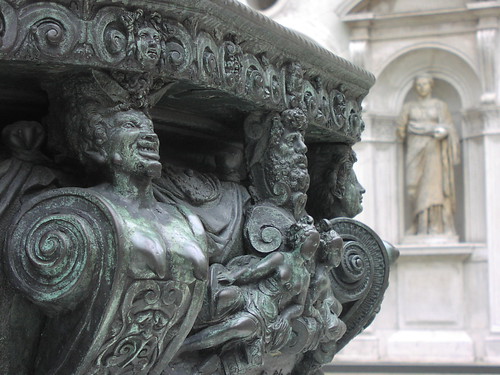
| - | In the large courtyard stand the two great [[Vere da pozzo|Vere]] borehole cast iron, finely cast in the fifteenth century. | + | [[Immagine:Arco Foscari.JPG|400px|right]]In the large courtyard stand the two great [[Vere da pozzo|Vere]] borehole cast iron, finely cast in the fifteenth century. |
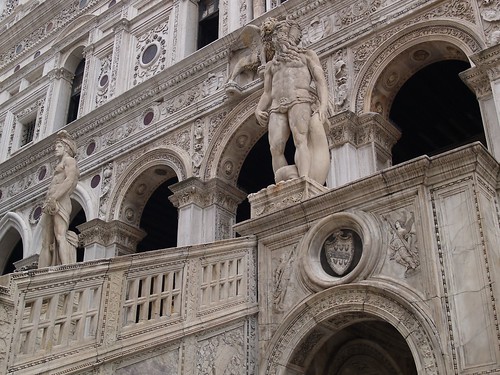
| - | + | Right behind is the [[Scala dei Giganti]] for the two huge statues of [[Jacopo Sansovino]] adorning the arrival on the summit. This was the place where the Doges swore allegiance to the Republic of Venice in the time of their recruitment in office. | |
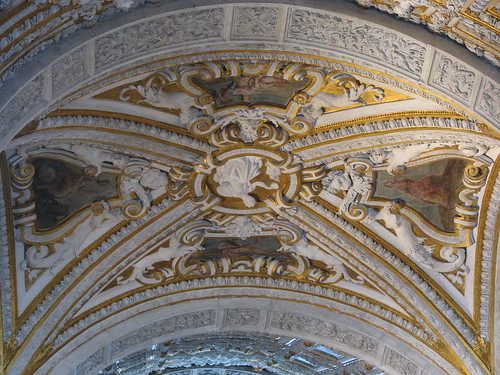
From the balcony of the first floor to access the '''Apartment Doge''' climb the famous [[Scala d'Oro|Golden Staircase]] by [[Jacopo Sansovino]], cleverly decorated by [[Alessandro Vittoria]] with the technique of stucco relief, recently recovered with special studies, trying to get back to execute the decorations as the Romans in its heyday and back in vogue in the late sixteenth century. | From the balcony of the first floor to access the '''Apartment Doge''' climb the famous [[Scala d'Oro|Golden Staircase]] by [[Jacopo Sansovino]], cleverly decorated by [[Alessandro Vittoria]] with the technique of stucco relief, recently recovered with special studies, trying to get back to execute the decorations as the Romans in its heyday and back in vogue in the late sixteenth century. | ||
| - | + | <googlemap lat="45.4335" lon="12.3403" zoom="16" width="400" height="400" controls="small" scrollwheel="zoom" type="map" style="float:left"> | |
| + | 45.433530084184866, 12.340307235717773 | ||
| + | </googlemap> | ||
</poem> | </poem> | ||
| + | =Foto= | ||
| + | {{:Palazzo_Ducale/Foto}} | ||
| + | |||
| + | =Video= | ||
| + | {{:Palazzo_Ducale/Video}} | ||
Versione corrente
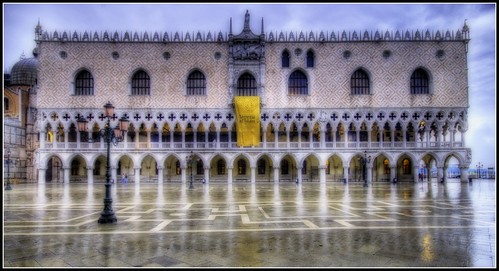

The first form of the Palazzo Ducale was like a castle, surrounded by walls and towers at the corners. Was destroyed by fire.
In the fourteenth century took to rifabbricarlo, and the work of expansion continued in later ages, including consideration of readjustments that took place after another fire, which occurred in 1483, 1574 and, perhaps the most terrible, in 1577.
The Basegio, Filippo Calendar, Bartolomeo Bon, the Rizzo, Peter Lombard, the Da Ponte, Scarpagnino, Jacopo Sansovino, Alessandro Vittoria and other architects employed the work them in this massive structure.
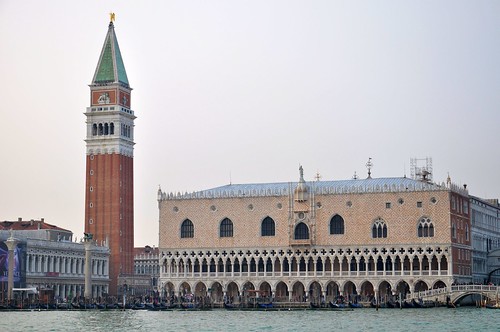
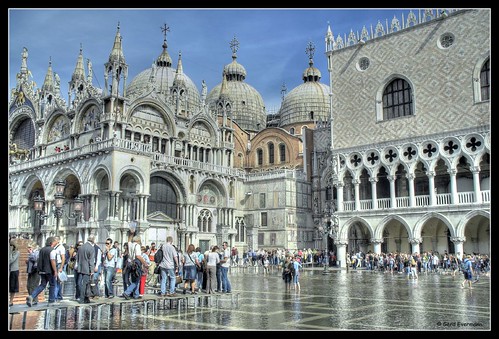
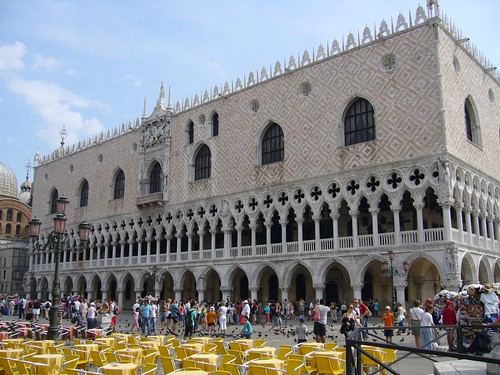
In 1342 construction began on the facade of St. Mark's Basin and was commissioned Filippo Calendario to build on the existing structures, a building that could house the nearly one thousand noble representatives for the assemblies that were to decide the fate of Venice. The same calendar carved reliefs that adorn the edges of the front, dedicating to Adam and Eve on the edge Piazzetta and drunkenness of Noah to the Ponte della Paglia.

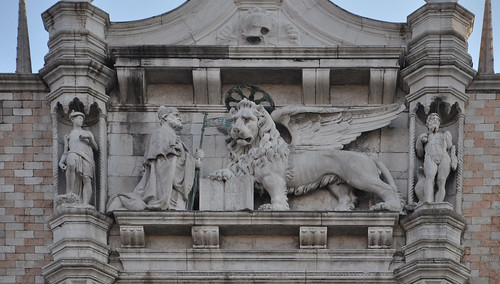

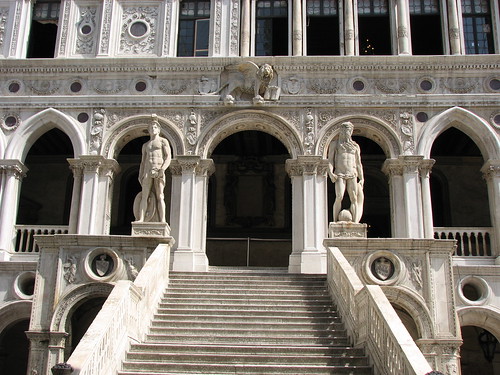
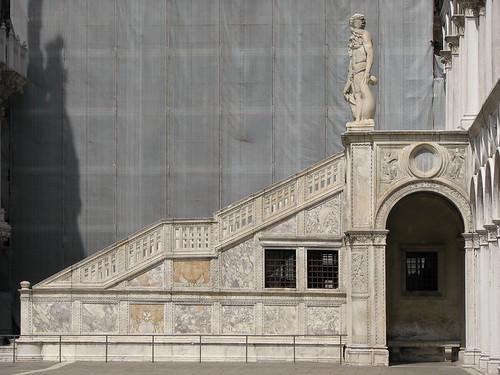
Right behind is the Scala dei Giganti for the two huge statues of Jacopo Sansovino adorning the arrival on the summit. This was the place where the Doges swore allegiance to the Republic of Venice in the time of their recruitment in office.
From the balcony of the first floor to access the Apartment Doge climb the famous Golden Staircase by Jacopo Sansovino, cleverly decorated by Alessandro Vittoria with the technique of stucco relief, recently recovered with special studies, trying to get back to execute the decorations as the Romans in its heyday and back in vogue in the late sixteenth century.
Foto
</gallery>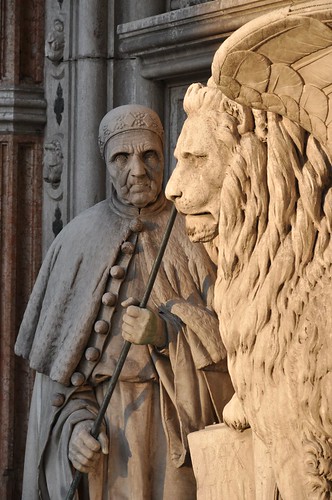
Flickr Error ( Photo not found ): PhotoID 63360268


Flickr Error ( Photo not found ): PhotoID 2055058659
Flickr Error ( Photo not found ): PhotoID 321035628
Flickr Error ( Photo not found ): PhotoID 2055848268
 Gondola_con_Felze |
 Corte_di_Palazzo_Ducale |
Video


- Apri YouTube
- Individua i video migliori
- Modifica la sezione relativa al video, inserendo il codice di ciascun video (l'ultima parte dell'indirizzo) tra <youtube> e </youtube>.
Esempio:
Per inserire il video che si trova all'indirizzo: http://it.youtube.com/watch?v=vTw8RNnM14k
Basta scrivere: <youtube>vTw8RNnM14k</youtube>
Categoria: Video